
SSL
SAMUDERA SHIPPING LINE LTD.
Surcharges
(0 items)Select Container Type & Qty
Booking Information
Cargo Information
B/L & Payment
Shipper / Consignee
Submitted orders start as "Pending". We will confirm with you shortly.
Similar Rates




Shanghai to Krishnapatnam FCL Ocean Route Overview
Shanghai(China) → Krishnapatnam(India) is one of the India-bound ocean export routes from China, carried by SSL(Samudera Shipping Line), with an average transit time of about - days, direct service, with stable transit times. Common container types include 20GP, 40GP, 40HQ, suitable for general cargo, electronics, furniture, appliances, machinery, garments and more (India).
Ocean FCL (Full Container Load) is ideal for bulk cargo. Compared to LCL (Less than Container Load), it offers lower unit cost, faster transit, and simpler handling. The rate above covers base ocean freight only. Surcharges (BAF for bunker, THC for terminal handling, ENS for manifest filing, etc.) are listed in the surcharge table. Actual costs may vary by season, fuel price and space availability. We recommend booking 7-15 days in advance and confirming the latest rate with your forwarder.
* Rates are based on SSL public quotes, valid until 2026-12-09. Actual contract prices may vary based on booking time, space availability, and peak/off-peak factors.
Port of Discharge: Krishnapatnam
    The Port of Krishnapatnam (IN, port code: INKRI), also translated as Krishnapatnam Port, is a deep-water port in the Nellore district of Andhra Pradesh on the east coast of India. It is operated and managed by Krishnapatnam Port Company Limited (KPCL).
    The Port of Krishnapatnam, commonly known as KPCL, is a privately built and owned all-weather, deep-water port on the east coast of India, located in the Nellore district of Andhra Pradesh. It is located about 190 km north of the port and city of Chennai and 18 km east of Nellore. The port is owned and operated by Krishnapatnam Port Company Limited (KPCL), which is 92% owned by the Hyderabad-based CVR Group. The London-based private equity firm 3i Group Plc owns the remaining 8% stake in KPCL.
     Port Development
    The first phase of port development involved an expenditure of INR 140 billion, and was completed in 2009, when the port was developed to an annual cargo throughput of 25 million tons. Two mechanized iron ore berths, one general berth and a mechanized general cargo berth were set up in this phase. The second phase of port development requires an investment of $2 billion, raising cargo handling capacity to 40 million tons. By 2017, the fully developed port is expected to handle 200 million tons of cargo per year. The expanded second phase will increase the total number of berths to 12, half of which will handle coal and the rest general, bulk and container cargo. The port's draft has also been enhanced from the original 18 meters to 21 meters.
     Container Terminal
    In September 2012, KPCL established a container terminal capable of handling 1.2 million TEUs per year. The terminal is equipped with 5 Panamax gantry cranes, a 650-meter-long coastline with two berths and a draft of 13.5 meters, and a channel depth that allows large vessels carrying up to 8,000 containers to berth. Its second phase of development will involve an investment of INR 1,100 billion and a further expansion of capacity by 4.8 million tons. KPCL has reached an agreement with the Container Corporation of India (CONCOR) to develop inland ports and inland container depots and container freight stations to facilitate trade through the port.
    Set to emerge as a dynamic major transshipment hub port on the east coast, the Krishnapatnam Port terminal has taken on several international container liner services.
    Given the growing maritime trade of India in the world market and the unprecedented growth of container trade and commodities, Krishnapatnam Port is building a world-class container terminal with excellent services, facilities and state-of-the-art infrastructure. By matching demand with supply, industry with port, rail, road with port and capital, it makes India's exporters and importers globally competitive.
     Cargo Handling
    When the port was inaugurated in 2008, iron ore constituted its most important cargo, peaking at 10.5 million tons in 2009. Due to the iron ore export ban from the Bellary-Hospet region of Karnataka, its shipments have declined, forcing the port to diversify its portfolio. Coal is now the primary commodity handled through the port, having expanded from less than 100,000 tons in 2008-09 to a volume of 11.3 million tons in 2011-12. The port now also plans to handle LNG cargo, automobiles meant for export, edible oil and fertilizer. In 2012-13, the port handled 21.2 million metric tons of cargo, three-quarters of which was imported coal. In the 2013-14 year, the port targets handling 25.16 million metric tons against a target of 28 tons. In the 2014-15 year, the port registered a very considerable growth of 60%, increasing the total cargo handled in the past year from 25.16 million metric tons to 40.72 million metric tons.
  Special Economic Zone
  A 12,000-acre Special Economic Zone (SEZ) is being established near the port by Krishnapatnam Port Infratech Private Limited, a special purpose vehicle set up through KPCL. The SEZ requires an investment of 600 billion rupees and is expected to create 30,000 direct jobs. The said SEZ is being designed by Mahindra Engineering and is a multi-product SEZ.
Carrier: SSL(Samudera Shipping Line)

Samudera Shipping Line Ltd..
This is a well-known shipping enterprise headquartered in Singapore with Indonesian state-owned background.
Company Basic Overview
Item Detailed Information Chinese Name Samudera Shipping Line Ltd. (Abbreviation: Samudera) English Name Samudera Shipping Line Ltd. Enterprise Nature Indonesian state-owned shipping enterprise (registered and listed in Singapore) Stock Code SGX: S56 (Singapore Exchange) Establishment Date 1993 (corporate entity) / 1964 (brand history) Headquarters Address Singapore (6 Raffles Quay)
Core Business and Routes
SAMUDERA's main business is to provide cargo transportation and logistics services to customers worldwide, and its business segments cover container shipping, bulk and tanker, agency and logistics.
- Advantage Routes: The company is deeply engaged in the Southeast Asia market, with services covering Malaysia, the Philippines, Indonesia, Thailand, Vietnam, Myanmar, etc.; it also provides shipping services to India-Pakistan (India, Pakistan, Bangladesh, etc.), the Middle East, and Australia-New Zealand (Australia, New Zealand).
- Operating Model: They use Singapore as a hub port to provide container cargo transportation services with other feeder ports in Asia, and also operate point-to-point transportation within the region.
- Fleet strength:
- Container ships: This is its main source of revenue, responsible for feeder transportation within the region.
- Bulk carriers: In May 2025, its subsidiary received two 66,000-tonne supramax bulk carriers. These new ships are equipped with SCR systems to meet Tier-III emission standards and feature shallow draft characteristics, making them highly suitable for the special navigational operating requirements of Southeast Asia.
Samudera Shipping's route network uses Singapore as its hub port and, through the “hub-and-feeder” model, covers four core regions—Southeast Asia, the Indian subcontinent, the Far East, and the Middle East—while continuing to expand into markets such as China and Northeast Asia.
Core Southeast Asia routes:
As the company's core market, the Southeast Asia route network is dense, with particularly significant advantages in connections to the Indonesian archipelago.
Indonesian archipelago routes: Operates multiple routes connecting major ports such as Jakarta, Surabaya, Semarang, Belawan, and Palembang, providing dense services with 1 to 3 sailings per week.
Intra-Southeast Asia routes: Services cover Malaysia, Thailand, Vietnam, Myanmar, the Philippines, and other countries. Specific ports include Port Klang, Penang, Bangkok, Songkhla, Ho Chi Minh City, Yangon, Manila, and others, with sailing frequencies of 1 to 4 per week.
Recently added routes:
Kuala Lumpur–Tanjung route (launched in May 2026): Singapore – Kuala Lumpur – Penang – Singapore, one sailing per week, strengthening connectivity in the North Sumatra region.
Batam-Myanmar direct service: Batam – Singapore – Port Klang – Yangon, weekly service, no transshipment via Singapore required.
Indian Subcontinent and Middle East routes:
This region is a key focus of the company's westward network, with operational support through its own offices (such as Dubai and Mumbai).
Indian Subcontinent: Operates multiple routes covering India's **Chennai, Kolkata, Mumbai, Mundra, Pipavav**, Bangladesh's **Chittagong**, Sri Lanka's **Colombo**, and Pakistan's **Karachi**.
Middle East and Gulf region: With **Dubai** as the regional hub, provides intra-regional services connecting upper Gulf ports, as well as regional routes linking the Gulf with the Indian Subcontinent. The **Straits-India-Gulf (SIG)** route connects Southeast Asia, India, and the Gulf region.
Recently added route: **Khor Fakkan India Express (KIX) (launched in July 2026), with port rotation **Nhava Sheva – Mundra – Khor Fakkan – Nhava Sheva, weekly service, strengthening connectivity between India's west coast and the Gulf region.
Far East and Northeast Asia routes:
The company is actively expanding into the Far East market, particularly China and Northeast Asia.
China routes: Service coverage includes major ports such as Ningbo, Shekou, Nansha, Qingdao, and Shanghai, with some routes operated by the company's own vessels.
Northeast Asia routes: Korea-Japan Shuttle (KJS) (launched in April 2026), connecting Japan's **Nagoya and Kobe** with Korea's **Busan**, weekly service, marking the company's entry into the Northeast Asia trade corridor.
Bulk and tanker routes:
In addition to container shipping, the company's bulk and tanker fleet is mainly used to transport **petroleum, chemicals, gases, liquefied products, and dry bulk, with business coverage spanning Southeast Asia as well as **Indonesia's domestic market**, chartered to customers through time charters, contracts of affreightment, or single voyages.
Summary: Samudera Shipping's route network is centered on Singapore, with the densest feeder services in **Southeast Asia (especially the Indonesian archipelago)**, while radiating outward through **Indian Subcontinent, Middle East, and Far East** routes, and continuously expanding network coverage by launching new routes (such as KJS and KIX).
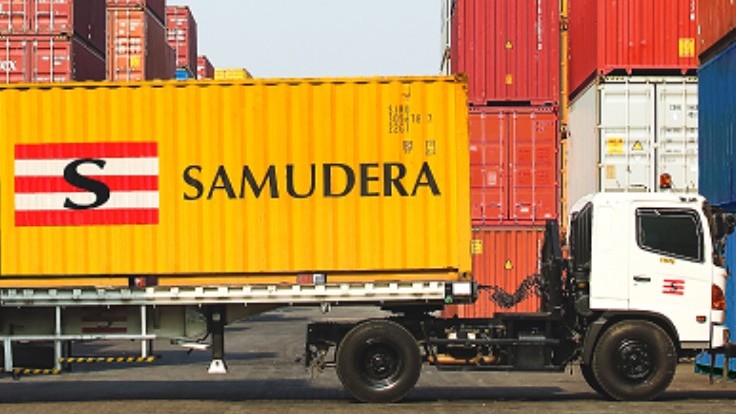
PT Samudera Indonesia Tbk.
Jl. Letjen S. Parman Kav. 35
Jakarta 11480
General inquiries:
Telp: + 62-21-5480088, +62-21-5347210, +62-21-5304185, +62-21-5347210
Official website: https://www.samudera.id/
Cargo tracking: https://www.samudera.id/