
About the Carrier
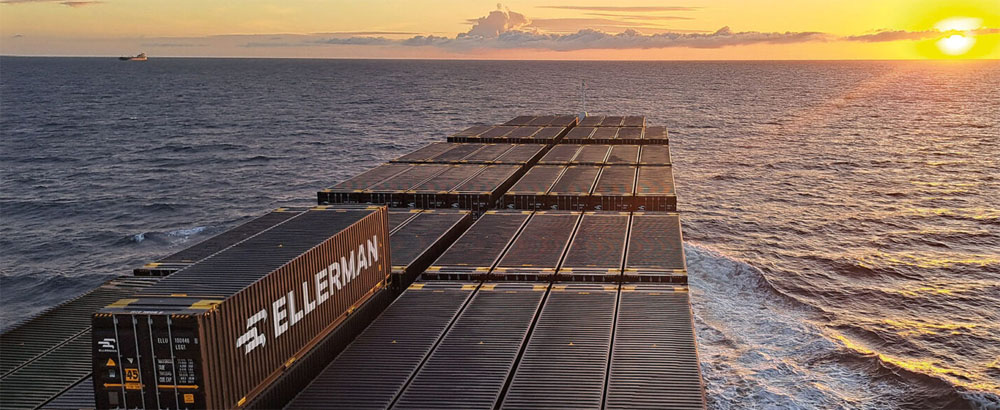
Ellerman Shipping Company: Ellerman City Liners
Ellerman, the Ellerman Shipping Company, was a British freight and passenger company that operated from the late 19th century through the 20th century. Founded in the late 19th century, the company expanded continuously by acquiring small shipping companies until it became one of the largest shipping companies in the world. During World War I and World War II, its merchant fleet suffered heavy losses, but it overcame the difficulties each time.
In the second half of the 20th century, competition and modernization trends in the shipping industry dealt the company a heavy blow. Its shipping assets were subsequently sold to larger companies, until the name was removed in 2004, and Ellerman finally ended its long association with shipping. However, since 2021, the Ellerman name has reappeared in the form of Ellerman City Liners to provide new container shipping services between the UK and China.
UK-headquartered freight forwarder Uniserve revived the Ellerman brand in 1892 and founded a new shipping company called Ellerman City Liners.

Container ship“Ellerman City Liners” (Image source: Universe)
Alphaliner's container shipping analyst conducted an in-depth analysis of a new British carrier. UK-headquartered freight forwarder Uniserve has chartered several ships this year and has now gone a step further by establishing a new shipping company called Ellerman City Liners, directly under Uniserve.
Ellerman City Liners has begun offering a regular service called GB Express, shipping from China to the UK. The full port rotation of GB Express takes about 60 days. The GB Express route uses four chartered vessels ranging in size from 2,464 TEU to 5,060 TEU. The vessels call at Taicang, Ningbo and Dachan Bay in China and Tilbury in the UK.
In its latest weekly report, Alphaliner explained that Uniserve initially began chartering ships only to add temporary capacity, but because the ongoing capacity shortage and port congestion are not expected to ease soon, the company decided to organize itself as a long-term carrier.
Uniserve is the largest privately owned logistics service provider in the UK. Uniserve's shipping business is called UniOcean, and it launched a new container shipping service under the UniOcean brand.
The history of the Ellerman brand dates back to 1892, and it was one of the largest brands in the UK before World War II. The brand was It ceased to exist after being acquired by Andrew War Shipping in 1991.
Five months ago, Uniserve President Iain ·Liddell revived the Ellerman City Liners name; his shipping career began as an Ellerman salesman.
History of Ellerman Lines:
The company was founded in 1892 by merchants John ·Ellerman, Christopher ·Furness, and Henry ·OHagan, who purchased the assets of the Liverpool shipping company Frederick ·Leyland and Co Ltd. With initial capital of £800,000, the company bought a fleet of 22 ships from the executors of Frederick ·Leyland; Ellerman, formerly the head of Frederick ·Leyland and Co., was initially managing director and Furness was chairman, but by 1893 Ellerman had taken the chairmanship himself.
In 1900, the company expanded by acquiring 20 ships from the West India and Pacific Steamship Company. It was then reorganized as Frederick Leyland (1900) with capital of £2,800,000. In 1901, the company was acquired by JP Morgan's International Mercantile Marine Company, but Ellerman remained chairman and owned 20 ships. He later acquired the Papayanni Steamship Company and its 8 ships. Using these assets, he founded the London, Liverpool and Ocean Shipping Company, headquartered in Moorgate, London.
The London, Liverpool and Ocean Shipping Company then acquired a 50% stake in the Glasgow City Line operated by George Smith and Sons in 1903, as well as a 50% stake in the Hall Line. Its capital was further increased, and its name was changed to Ellerman Lines. The company was headquartered in Liverpool and Glasgow, with a subsidiary in London. Further acquisitions followed. In 1904-05, the company acquired Liverpool's McGregor, Gow and Co, later the Glen Line. In 1908, it acquired the financially troubled Bucknall Steamship Company, which operated several routes between the UK, South Africa, the Near East, and North America, and in 1914 renamed it Ellerman and Bucknall Steamship Company.
The Ellerman Group now held a dominant position in the Mediterranean and Near East. By 1914, the Ellerman Group controlled four subsidiaries: Ellerman City Line, Ellerman and Bucknall Steamship Company, Ellerman and Papayanni Lines, and Hall Line) (although the City and Hall Shipping Company is often referred to as one company — Ellerman City and Hall Shipping Company.
Wartime service and purchase of the Wilson Line:
Ellerman was a large shipping company, so after the outbreak of World War I, most of its fleet was requisitioned by the British government for use as troopships, ammunition ships, or converted into armed merchant cruisers to expand the Royal Navy. Ellerman continued to provide backbone services with its remaining ships, and in 1916 personally acquired the Wilson Shipping Company of Hull, placing 67 short-sea vessels into company service.
The Wilson Shipping Company was renamed Ellerman Wilson Shipping Company and traded as an independent entity, with its distinctive livery of red funnels with black tops and dark green hulls on most of its ships. This contrasted sharply with the light yellow funnels with black tops and white dividing lines used by Ellerman Shipping Company's grey-hulled ships.
The Calypso, launched in 1897. Ellerman Wilson Shipping Company acquired this ship in 1920 as part of World War I reparations. “ Sir John · Ellerman's various controlled companies suffered heavy losses. In total, 103 ocean-going vessels were destroyed, with a total tonnage of 600,000 to 750,000 tons. These included the passenger liner City of Athens, which struck a mine near Cape Town in August 1917. The City of Winchester (1914) was the first merchant ship destroyed in the war; it was captured by the German cruiser Königsberg while returning from India with a highly valuable cargo of agricultural produce. Another passenger liner in the Ellerman fleet struck a mine far from Europe. The City of Exeter was a fine passenger liner that struck a mine in the Indian Ocean about 400 metres from Bombay. No. 1 cargo hold immediately filled with passengers, and the captain ordered passengers and crew to leave the ship. The captain and chief engineer then returned and, at great risk, carried out a thorough inspection of the vessel. They decided that, with great care, the damaged ship could reach Bombay and sail under its own power. The passengers reboarded, and the ship arrived safely in port. ”
Ellerman · Wilson Shipping Company's City of Paris, launched in 1922. Ellerman Shipping Company strove to restore pre-war levels of service after the war ended. This included acquiring several German passenger liners and ordering new ships. Before long, the old passenger and freight service network was restored. John · Ellerman died in 1933, aged 37 million pounds, a baronet.
By the outbreak of World War II in 1939, the fleet had been successfully rebuilt and expanded, and the Ellerman Group owned a total of 105 ships with a total deadweight of 920,000 tons. This made the Ellerman Group one of the largest fleets in the world. Its ships fell into four categories: combined passenger and cargo ships; cargo ships with limited passenger accommodation; pure cargo ships; and short-sea trading vessels serving the Mediterranean. Many of these ships were subsequently requisitioned by the British government, while others were retained as cargo ships for carrying supplies to Britain.
Wartime losses were heavy, especially from Germany's U-boat fleet. 41 ships were sunk by submarines, including SS City of Benares, 7 were sunk by air attack, 3 were sunk by mines, and 1 was sunk by a surface raider. In total, the Ellerman Group lost 60 of its 105 ships.
Post-war recovery:
TheLiberty ship “City of Shrewsbury” was launched in 1943 under the name “Ben ·H·Miller”. Ellerman and Papayanni bought it in 1947. As in the period after the defeat in World War I, they implemented a new construction program. A new policy meant building fast steam cargo liners that could carry up to 12 passengers and were quite comfortable. Crew accommodation was also improved. Their focus was on rebuilding international trade routes, and to this end they bought 12 cargo ships they had managed during the war directly from the government. By 1952, 25 of these new 12-passenger liners were in service, with a total of 45 new ships after the war, plus another 14 for the Portuguese trade routes and Mediterranean services. By 1953, Ellerman's fleet had been almost completely rebuilt, with a total of 94 ships and a deadweight of 900,000 tons.
In 1967, as containerization began to rationalize world shipping services, Ellerman Lines (excluding Wilson Line) controlled 59 ocean-going vessels.
The final decline:
However, as newly independent countries such as India established their own shipping companies, trade became increasingly difficult. With the advent of containerization, the nature of shipping was also changing. In 1966, Ellerman Lines joined the Associated Container Transportation (ACT) consortium and successfully began containerizing its Mediterranean services. By the early 1970s, the Ellerman Group had expanded its commercial interests into other fields, including hotels, winemaking and printing. In 1973, it merged all its shipping companies into a single division. A decade later, its profitability plummeted and it suffered heavy losses. The entire business was then acquired by the Barclay brothers. In 1985, the shipping business was the subject of a management buyout and subsequently sold to the Trafalgar Group, which in 1987 merged it with its ownership of Cunard to form Cunard-Ellerman Shipping. In 1991, they transferred it to the Andrew Weir Shipping Group, which sold it to Hamburg Süd in 2003. In 2004, the Ellerman Lines name was dropped, and Ellerman Lines ceased to exist. In 1970, the City of Colombo left Glasgow
Revival of the Ellerman name:
Ellerman City Liners, a subsidiary of UniOcean Lines, reopened in 2021, marking the first time the Ellerman name had been put back into commercial use since 2004. The company currently operates container shipping services between Europe and the United States. Container shipping services between Europe and China.
Related Freight Rates
No FCL rates available for Ellerman Lines
Frequently Asked Questions
Where can I find routes served by Ellerman Lines?
Explore the Ellerman Lines profile and search your ports on Awice Logistics to check available services.
How can I check Ellerman Lines freight rates?
Enter the origin and destination in the ocean freight search, then review available quotes for Ellerman Lines (Ellerman).